Radio Rounds episode
The Underwear Drawer
October 16, 2011
Streaming audio is not yet linked for this archival entry.
About this episode
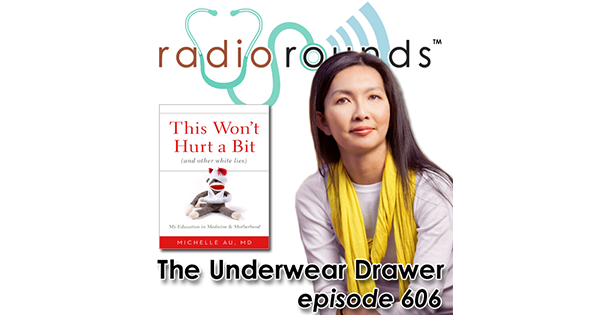
This episode aired on Sunday October 16, 2011. Hosts Lakshman Swamy and Casey McCluskey speak with Dr. Michelle Au, an anesthesiologist, author, and longtime medical blogger, about the human side of becoming a physician. Dr. Au reflects on how The Underwear Drawer began as an online journal during medical school and evolved into a candid record of training, marriage, parenthood, and life in medicine. She discusses writing her memoir, This Won’t Hurt a Bit (And Other White Lies), raising a child during residency, and the generational shift toward recognizing that physicians have meaningful lives and responsibilities outside the hospital. The conversation explores how honest storytelling can demystify medical training, preserve empathy, and strengthen understanding between doctors and patients. Through humor and vulnerability, Dr. Au shows that medicine is not simply a career or an identity, but one part of a full human life.
Read along
Episode transcript
Transcript lightly edited for clarity.
00:00You're listening to Radio Rounds, a talk show created and hosted by medical students. Coming up on today's show. You know, you can see how this person, over the course of 10 years, and see what that development is like from being a very young medical student to being attending. And I think that that's a great experience also for patients to see, this is why my doctor acts this way. This is what my doctor's been through. And it just really humanizes the doctor-patient interaction, the process of becoming a doctor,
00:25and takes a lot of the mystery out of the process. That was Dr. Michelle Au. Coming up soon on Radio Rounds. Welcome to Radio Rounds, everyone.
01:03My name is Lakshman Swamy. And I'm Casey McCluskey. We're glad you could join us for today's Radio Rounds with one anesthesiologist that won't put you to sleep. It's pretty cool to be able to follow the development of Dr. Au's perspectives on life and medicine from her second year of med school to today through her blog and see how there are some things that are just true for all medical students and probably for all people over time. Here's our conversation with Dr. Michelle Au.
01:29So Dr. Au, you have written such an extensive and such a personal blog. Really you can, a reader can go through and really get to know you through it. How do you feel that that's translated as, you know, as a physician? I can tell that there's kind of a line that you're trying to draw with anonymity, but at the same time, going to be that hard for someone to really find out, you know, who you are and all that. It always started off as a very personal blog because like I said, when it started, it was
01:53an online journal. That's literally what it was. I was in medical school with a second year medical student and I was doing a lot of stuff. It was really interesting, but I just didn't have a lot of time to share my stories with my friends and my family, many of whom didn't live near me. So I thought by putting the stories up online that people could share in the experiences that I was going through in this exciting time of my life.
02:12As the blog has developed, I've kind of kept that tone that it is still sort of an online journal. I don't talk about everything, obviously, but, you know, just the little stories, the little things of life. And if you read the blog now, you'll notice that actually not that much of it is about medicine specifically, even though people think of it as a medical blog because I happen to be a doctor. But it's just, you know, it's just about my life.
02:31I happen to be a doctor. Some of the stories are about work, which is in the hospital, but many of the stories are not. You know, I think that's where I'd like to keep the blog. A lot of medical blogs now are sort of information disseminating or a clearinghouse for various links and articles related to medicine or public health, which is great because I think that that kind of blog, first of all, gives a lot more information and access to both patients
02:55and doctors. So it kind of makes a community and creates more of a sense of immediacy with medical care and that kind of thing. However, I never really aim to do that, and I'm trying to stay away from that kind of blogging because I feel uncomfortable with the idea of being a pundit, you know, espousing to be an expert because I'm not. I just want to be someone who happens to be a doctor who talks about my life. And I think that people do appreciate that, in particular medical trainees, because,
03:21you know, you can see how this person, over the course of 10 years, and all my archives are online. You can easily read them like you noted and see what that development is like from being a very young medical student to being attending. And I think that that's a great experience also for patients to see this is why my doctor acts this way. This is what my doctor's been through, and it just really humanizes the doctor-patient interaction, the process of becoming a doctor, and takes a lot of the mystery out of the
03:45process. And I think that's what's so exciting, especially from our perspective as medical students, is there's so much importance in humanism in medicine, and I think a lot of medical blogs, they can be, you know, fantastic, like, for example, Dr. Pho's blog. It has so much information on it. It's a great resource. There's this different aspect of medicine, which is that ability to be, you know, human, and I think that that's something that your blog really carries through. Do your patients know that you have a blog?
04:15Do, you know, what would their, what's their attitude towards it? My patients, by and large, you know, I've never had a patient, well, I've had one, one patient who recognized my name, but, you know, like I said, with the practice of anesthesia, it's just very different. With someone who's like Kevin, Kevin Pho, who we were mentioning, he is, you know, in primary care, so he has an office with his name played on the door. He has business cards, patients make an appointment to see him, same with my
04:42husband. My husband is a surgeon, so he has an office and patients look him up and go see him. So there's a lot more sort of lead time to them Googling my husband's name or Googling Kevin's name or what have you. With anesthesia, patients show up for surgery with their surgeon who they've, you know, chosen, and then I go meet them the day of surgery for the most part. So they don't have a lot of, like, forewarning, and honestly with the way
05:03anesthesia works, a lot of times the recollections of our interaction may be a little bit hazy afterwards, so it's one of those things where it's like it's a good and a bad thing because I do, I used to be in a pediatric residency, as you may know, so some of what I miss of primary care is developing those relationships with patients, and who knows, if I had stayed in pediatrics, I may have more patients that actually realize that, you know, I have a blog on that, who can say now, you know, but just with
05:29anesthesia, they just don't have a lot of forewarning, and not that many people come to the hospital and say, I want this anesthesiologist with the blog because they just don't know, you know, who I am or where I work, so it helps a little bit with the patient privacy issue too. You've also cultivated quite a following on the blog, a regular following, you can see it in the comments, you can see people kind of, you know, coming back and having conversations with you.
05:55What was it like getting, you know, starting to develop that relationship with this crowd of people? I think it's incredible, you know, as a writer, you don't write in a vacuum, but you know, most people write in order to be read, so it's very rewarding to write and have such immediate feedback, be it good or bad, and I really have been totally open about the fact that I don't mind when people disagree with me, I don't get offended per se unless
06:18it's a very personal attack or something like that. I enjoy hearing all sorts of opinion, and maybe part of that is being a doctor that, you know, people will disagree with you, and that's fine, they're open to do that, and if you put anything out in public, you're opening yourself up to people agreeing or disagreeing with you, but it's just tremendously rewarding to have any kind of feedback, and to have feedback over many years from the same people is wonderful because you
06:37feel like you're building a sense of community. I think a lot of it is what I write about, the fact that it's so personal makes it more conducive for people to develop that sort of more intense relationship with the blogger as opposed to someone who writes more about issues and less about themselves, that, you know, people will say, oh, I feel like I know you, they know about my kids, they know about their personalities, they know about my husband, they know about, you know, every step of the way from medical school
07:02up until now, and it's wonderful. Granted, sometimes it's a little bit weird when you're meeting someone, they know everything about you, and you know nothing about them, you feel like it's unfair, like I'm like, tell me all about yourself very quickly so I can catch up, but it is wonderful to feel like you've had such a personal impact on people, and I hope that I can keep that up. We're all really excited as medical students especially for the release of your new book, This Won't Hurt A Bit.
07:26Could you just tell us a little bit about the book? There's a lot of medical memoir out there, and I think that all of us have read at least some of it, you know, there's some very prominent medical memoirs out there who do an excellent job, but there's not so much out there about the personal side of medicine, meaning that lots of medical memoirs talk about the medical experience and about the patients in the hospital, but not so much about the experience of being a young
07:50doctor, learning, you know, the tools of the trade and what that experience is personally like. Also in particular, and this is a topic that's coming up more and more, there's not that much about balancing work and life. Residency and medical training is such an all-consuming process that really when you have stories about medicine and training in medicine, it just naturally defers to all medicine because that's what we're sort of taught is the most important thing, but you know, you have to realize that
08:16medical students and residents are people too, and some of us have fairly significant responsibilities outside of the hospital. So how does one juggle two extremely important all-consuming jobs? And in my book, I specifically talk about being a resident and being a parent, a new parent at the same time, and how does one balance these two all-consuming, you know, rules? In my perception, this is kind of a change that medicine as a profession is going through right now that more and more
08:41students who are graduating are kind of trying to choose some kind of work-life balance. Do you have any comment on that? Yeah, that's definitely a trend in medicine, and you know, I think it's hard for young doctors because there's definitely a generational schism that I'm sure that you felt in many young doctors sort of looking at a job in medicine is not just their primary role, but one of many roles. And some of the older generations were raised in more of the, let's say, more draconian culture of medicine
09:12where, you know, being a doctor is the main, most important thing in your life, sort of look at the younger doctors who are trying to find a work-life balance or choosing their field of medicine or their role in medicine based more on trying to balance work and life as being lazy or copping out or, you know, but I've heard that constantly, basically, throughout my training. And it's not even necessarily that they're just trying to be mean, but it's just really a cultural
09:36change, it's a sea change in medicine. And you could say, oh, maybe these younger doctors aren't as committed to medicine, they are not willing to put in as much time as the older generation who would work 80 to 100 hours a week with no complaints because that's what was expected of them. And I think that's one argument, but I think the other argument is that times are changing and the culture of medicine is changing, just like medicine itself is changing with new technology.
10:01And I think in order to recruit the best and the brightest to come into medicine, which is, frankly, you know, as someone who is a doctor and loves your job, it is, frankly, a tough sell sometimes to explain to people why you want to be a doctor because, you know, these days, you know, it's a lot of hard work, increasing complexity in patient care, more and more patients, more demands on you, more medical legal liability, let's be frank, and just decreasing reimbursement, all sorts of things
10:26that make lots of older doctors wish that they hadn't gone into medicine, and even my own parents sort of encourage me not to go into medicine for many of those reasons. So it's a tough sell, and I think that in order to get the best and the brightest, as we always have in medicine, that you have to make allowances for the fact that doctors are human beings too, and they should be allowed to balance work and life, just like, you know,
10:48every other profession. Sure. I think what's really exciting about the book, the message that I'm seeing is really that you can see these things as insurmountable challenges before you do them, but by doing them, you just kind of do it and it works out. That's sort of what medical training is like. I mean, when you start medical training, particularly that first day of third year medical school when it's like the first day on the wards, and you see what everyone is
11:14doing, and it just seems like that leak from being a preclinical medical student to, and you look at your intern and what he or she is doing, you're like, how did they get there? Just like, unimaginable, the gap, seemingly the gap between the two of you. But the great thing about medical school and the scary thing is they just throw you right in there, you know, it's like, here's your patients, go. And you're like, I don't know what to do. But you're put in a situation where you
11:39have to act, you know, and some patients are very sick, they don't, you know, they're too sick to care that it's your first day of third year medical school. So you just do it, you know, you're just put in that situation, people are counting on you, what are you gonna do, sit in the corner and worry about how you can't do it? Or you just look at the people around you, ask for help, and go in and do it, and that is the great thing about medical school.
11:59Your audience at the start, I would think, was largely medical, whether medical students, residents, or whatever involved in health care. The book is really a transition, it seems like, to really bring the story to a wider audience. I think you're right, a lot of, you know, even with the book, a lot of the people who are reading it or responding very, you know, positively to it are people who are in medicine, and I think that that's gonna be natural any time
12:24a medical book comes out. A lot of doctors and medical people are gonna read it because it's very immediate to their experience. And, you know, I've had so many nurses and, you know, other people talk to me, being like, oh, you know, I was reading the book and it just took me right back to when I was training and it's so familiar. So, you know, there's always gonna be that. However, my intent in writing the book was to sort of shine a light on this process
12:45for everyone, and I did take special care, or my editor especially did because sometimes I didn't realize that I was talking in medical jargon, but I did make a point to demystify a lot of the medical process, especially given that it was speaking about a layman basically learning to become a doctor, which is what I was, you know, when I got fresh out of college. I think there's incredible value in that, and I think especially now with all this talk of, you know, health care reform
13:10and our doctors being paid too much and all these sorts of things, that there's a lot more antagonism between doctors and patients now than there were, you know, back in the day historically when patients would come and just trust their doctor unequivocally. I think there's a lot more antagonism now. You probably feel it on the wards too. And it's sort of a shame, and I think it's coming from a place of us not understanding where the other's coming from, both from doctors not really understanding
13:32what it's like to be a patient, and that experience being so helpless is really a terrible experience to be hospitalized, and from patients not understanding what the doctor's going through and why they respond in certain ways and what pressures they're under. So I think that my ultimate goal is obviously for everyone to read the book, that would be wonderful, but I really want to make a big push to get it out to the regular community, the non-medical community, because I think that's where a lot of strides
13:58are gonna be made in just bridging communication and more understanding between the two worlds. And the book isn't the only way you're doing that. You're writing a new column. Yeah, I have a column with Psychology Today, and what I really want to focus on is about the human side of medicine. So really, all of my column pieces so far, and I'm working on another one, are about that aspect of medicine. Not so much the technical side, not so much the science,
14:22but the experience of being a doctor, taking care of patients, and sort of the human face behind the medical edifice. And hopefully that's helpful for people and gotten a lot of attention so far, so I'm hoping that I can keep that up and that it's interesting for people to read. I think it definitely is. For us at Radio Rounds, humanism it's such a big part of what we're trying to emphasize, and it's great to have role models like you out there
14:44who are practicing physicians who live this every day of their lives and try to get people to understand. Well, thanks. That was Dr. Michelle Au, anesthesiologist, mother, blogger, and human. Yeah, it's definitely fascinating to see the development. I mean, I'm in my third year now, and I was in her position as a secondary medical student not so long ago, and to see where her blog goes and kind of project that far forward, it's intense. It's actually a bit frightening to think
15:14that that is going to be our future a little bit, that marriage could be coming up, that children could be coming up, and that we're gonna have to do it along with taking on all the responsibilities that we have, and she was able to do that no problem. And for those of you who haven't been following her blog, it's definitely easy to get into, but check out Michelleau.com and click on the Photos tab, and you can read a sort of photo by photo synopsis
15:42of that whole journey, which is just awesome and hilarious to see it captured so succinctly. And it's great because you don't even have to be in medicine to appreciate how kind of ridiculous it can be to be a professional and a parent at the same time, or a professional and in a relationship. I think it's something that kind of crosses boundaries of any professional career. What do you think it would be like to actually deliver and raise a child during residency?
16:08It blows my mind, I mean, how busy you, like I see the residents working and they work hard, and they have to be very focused and dedicated, and to be pregnant and deliver a child during residency is just, obviously, Dr. Au is not the only one who's done it, but that experience has gotta be unbelievable. I have to set my alarm on my phone to remind me to eat sometimes. I can't imagine going through something like a pregnancy, and I mean, I have classmates who've done it.
16:36I know that it's possible. I could not do it myself, I don't think, but I mean, I guess when you are presented a challenge like that, you rise to it and you make it work. She certainly has made it work. There's a really funny picture on the website of what looks like a pretty dirty, dark, it's like a shower stall in this OR locker room where the caption actually reads that there's a toilet mop leaning up against the pump she used to pump breast milk
17:09while she was in residency. It's true, you sleep when you can, you eat when you can, I guess you pump when you can and where you can, you know, that she certainly found at least a little bit of privacy. I guess it's better to do it in there than in the OR room itself, you know? And you know, Casey, this is one of the topics that I think medical students are talking about more and more nowadays, that really the field of medicine is changing.
17:33You know, it used to be that doctors were so 100% dedicated to their job and it's not that we're not dedicated now, but there really is more of a space being made for a personal life. I agree, I think that there definitely is a different perspective, probably from both of our parents' generations. Both of us have parents who are physicians and I think we saw that medicine demanded much more of their time and now it was probably Dr. Au's generation that started to take back some of that personal time
18:05and our generation now sees it as something that's a must. It's definitely something that I think is much more available to us than it was, you know, for our parents. I mean, both of our parents obviously raised children being, you know, full-time physicians, but now with the work hour limitations in residency and there's just a general feeling of lifestyle becoming so important in medicine. I mean, you see those fields becoming more and more popular that emphasize the ability to be both a full-time physician
18:35and yet have a life outside of medicine. I mean, that's, I think, part of the reason why fields like dermatology are so popular now because you can work, you can work with patients every day, you can be a full-time doctor, but still have plenty of time to take care of your family. And I know it can be frustrating for patients to not have doctors as available as they may have been in generations past, but at the same time, I think that there is a greater understanding of patients
19:03that doctors do need to have a life and that they actually do appreciate a doctor who is well-rounded and is a person and not just a doctor. Casey, what do you think about going to see a doctor yourself? Do you think it's different when you see a doctor who is 100% all the time basically living in the hospital versus one who has that life outside? Do you think it's a different experience for you? Do you think it, in some ways, it might be a better experience or a worse experience?
19:28I know in my own experience with breast cancer, as I went around trying to find the right doctor for me, sure, it was important that my doctor was knowledgeable, but for me, I needed to have more of a human connection with them. I didn't ask for their grades. I didn't ask where they went to medical school. I didn't wanna know what their board scores were. I wanted to know if they could understand me as a person and taking that personal time allows a person
19:51to develop those human connections with others. If you wanna know more about Casey's story, definitely check out radiorounds.org and click on video rounds where you can see powerful interview where Casey talks about her experience being diagnosed with and being treated for breast cancer while in medical school. You know, Casey, I think that this is just a perfect example of what you're looking for in a doctor that's more than just the medicine because, as you say in that video, you were trying to find a physician who understood you,
20:19not just for some kind of treatment I would receive. It alters the course of your disease and recovery because their understanding of you is so important to the way that you will be treated. It did. I think I talked to about five oncologists before I settled on one and I settled on the last, I shouldn't even say settled, but I decided to go with the last one and he was the only one who asked me what I was doing right now with my life,
20:47which was medical school, and then he asked what specialty I was even considering going into. At the end of my first year, it was a little bit of a daunting question, but he said, I need to know if you wanna do neurosurgery because that's gonna change how we treat you. Some of the treatments could have affected my fine motor skills and if I needed to be able to sew in the tiniest little blood vessels, he needed to know that so that he could change my treatment as it went
21:11and that one question was exactly why I went with him. He wanted to treat me as a whole person, not just the tumor that was growing in my breasts. And I mean, Casey, you're talking about how you can't even imagine yourself going through pregnancy while in medical school or residency and yet obviously you dealt with cancer. So I think it just shows the importance of being able to deal with things that come your way, even if they're by choice, even if you decide to have children during residency
21:42or something like that. The fact that you can rise to the occasion and the importance of taking that time out for yourself. Yeah, I certainly learned the importance of taking time for me. You just need sometimes to take a time out and say, I need to step away for myself. And I think that's something that Dr. Au really gets into. The importance in any profession of taking a step back, laughing at yourself, laughing at what you're doing and just remembering that we're all human
22:10and we're all kind of in this together. I think it really is so important to step back and be able to kind of laugh at yourself. And really, that's what so much of Dr. Au's writing is about. I mean, her new book, This Won't Hurt a Bit, it has so many of those ups and downs, there's points when you're actually just cracking up while you're reading it. And there's other points where it really is, it's emotional and it gets you. And she draws these hilarious comics
22:37that are the Scutmonkey comics that I think anyone in the medical field can relate to but really anyone who's reading them will laugh as they read them. And if you want a funny person to follow on Twitter, Scutmonkey on Twitter is just hilarious. Something she just tweeted recently that has become one of my favorite tweets really shows just how down to earth she is. It was, surely this makes me a bad person, but when I read about a lodging being eco-friendly,
23:03all I think is no air conditioning and kind of follows along the lines of what I feel like too, my idea of camping is no cable or something like that. So I really like her down to earth perspective and it certainly shines through under tweets. And I think that's one of the things that is so appealing is that she's not like a lot of these medical bloggers and authors and all this where it's really centered in the fact that she's a doctor.
23:30For example, the book, as you said earlier to me, Casey, it's a book written by an author who happens to be a doctor. Just like her tweets are a combination of all these different things. And really, so many of them are not anything to do with medicine, but it's just her personality is so easy to connect with and you just get it. I love when she talks about her kids. They certainly are one of her favorite subjects to make fun of, to laugh at,
23:56and to also just tell funny stories about and just helps make her such a relatable person. You mentioned her kids and I'm wondering, what would it be like to have so much of your person? We've talked about how she's chronicled. We've talked about how she's chronicled so much of her professional life, but along with that, so much of her personal life is on her blog and in the book and everything. She's so open about things. I mean, so open about how she,
24:24that's the whole purpose of the book is that nature of what it was like to be a mother while in school and all that. That nature of what it was like to be a mother while being so busy, but also just what her family is like, what her life is like. Can you imagine being that open about everything that you've gone through? No, it's one of the things that amazes me. I certainly have talked about my story. I've told my story.
24:48It's been out there and it's something that I'm happy to discuss, but it's funny. I feel like I've been pretty open about sharing my own story and things that have happened with me. Then I go and I read her blog and I see just how much she shares about very personal things. I know after my whole experience, I had kind of kept a journal along the way. Certainly didn't blog about it on the internet, but I took that journal and published it
25:14into a couple copies. I probably have 10 copies out there and there are a few people who have them. I know there are different people who have asked to read it and I kind of panic when people want to read it because it's so personal. When I hand the book to them, I feel like I'm handing them a little, almost like a diary and she does it very openly and has no problem. It's something that's a little bit tougher for me to do because you just kind of value
25:40that privacy a little bit, but I appreciate so much of her honesty and how she's able to do that. It's so candid, it's so honest, it's so open and that's why there's so many times when you laugh, that's why there's so many times when you really get what she's going through. Yeah, I think what you see is what you get with her and I think the brilliant part of it is how much of yourself you can see in her and that's why you laugh so hard
26:04because it could be you right there. Definitely share with us your thoughts as well about Dr. Au's work, about the interview if you've read her book or about what it would be like for you to try and go through these experiences. And of course you can email us, contact at radiorounds.org is our address. And thanks again to our guest today, Dr. Michelle Au. Join us next week on Radio Rounds. Our guest will be Dr. Meg Sullivan, a pediatrician working in Guatemala
26:31with the Timmy Foundation. That's next week at noon on WWSU and midnight on WYSO and online at radiorounds.org. Join us next week on Radio Rounds. Our guest will be Dr. Meg Sullivan, a pediatrician working in Guatemala with Timmy Global Health, an organization committed to serving children in an international setting and empowering others to do the same. That's next week at noon on WWSU and midnight on WYSO and online at radiorounds.org. Also on our website, be sure to check out this week's writing round segment,
27:08Surgery and Public Health, written by Andrew Ibrahim, MS4 at Case Western Reserve University. He argues that surgeons will play a key role in the future of public health. Find out why at radiorounds.org slash writing-rounds. Writing-rounds is a place for any of our listeners and contributors to provide their own opinions on medicine and healthcare. We'll showcase those short essays every week on radiorounds.org. If you have an idea, feel free to send it our way. You can email us, like us on Facebook,
27:39and follow us on Twitter. All that information is on radiorounds.org, where you can now also listen to past episodes on demand. Podcasts of all our past episodes are also available as free downloads on iTunes. Just search the iTunes store for Radio Rounds. We'd now like to thank and credit those who made today's show possible. Production made possible in part by MedPlus Advantage, sponsored by the American Medical Association, providing group disability and life insurance to students and residents through participating educational institutions.
28:11Visit us at medplusadvantage.com. Radio Rounds is proudly sponsored by the Student Doctor Network, online at studentdoctor.net. Have questions about medical school or residency? Check out SDN Answers to view frequently asked questions or ask one of your own. Available online at studentdoctor.net. Thanks to our entire team who works hard here at Radio Rounds to bring you brand new episodes every week. And thanks most of all to everyone listening. Of course, please remember that the views and opinions expressed on Radio Rounds are not representative of the views and opinions
28:45of the partners of Radio Rounds or of the Wright State University Boonshoft School of Medicine. Again, join us next week or download our next podcast and definitely check out radiorounds.org for more information. Have a great week, everyone. My name is Casey McCluskey. And I'm Lakshman Swamy. And one day, we'll be your doctors. Here come the radio rounds. We're rounding, we're rounding, we're rounding. Welcome to Radio Rounds.